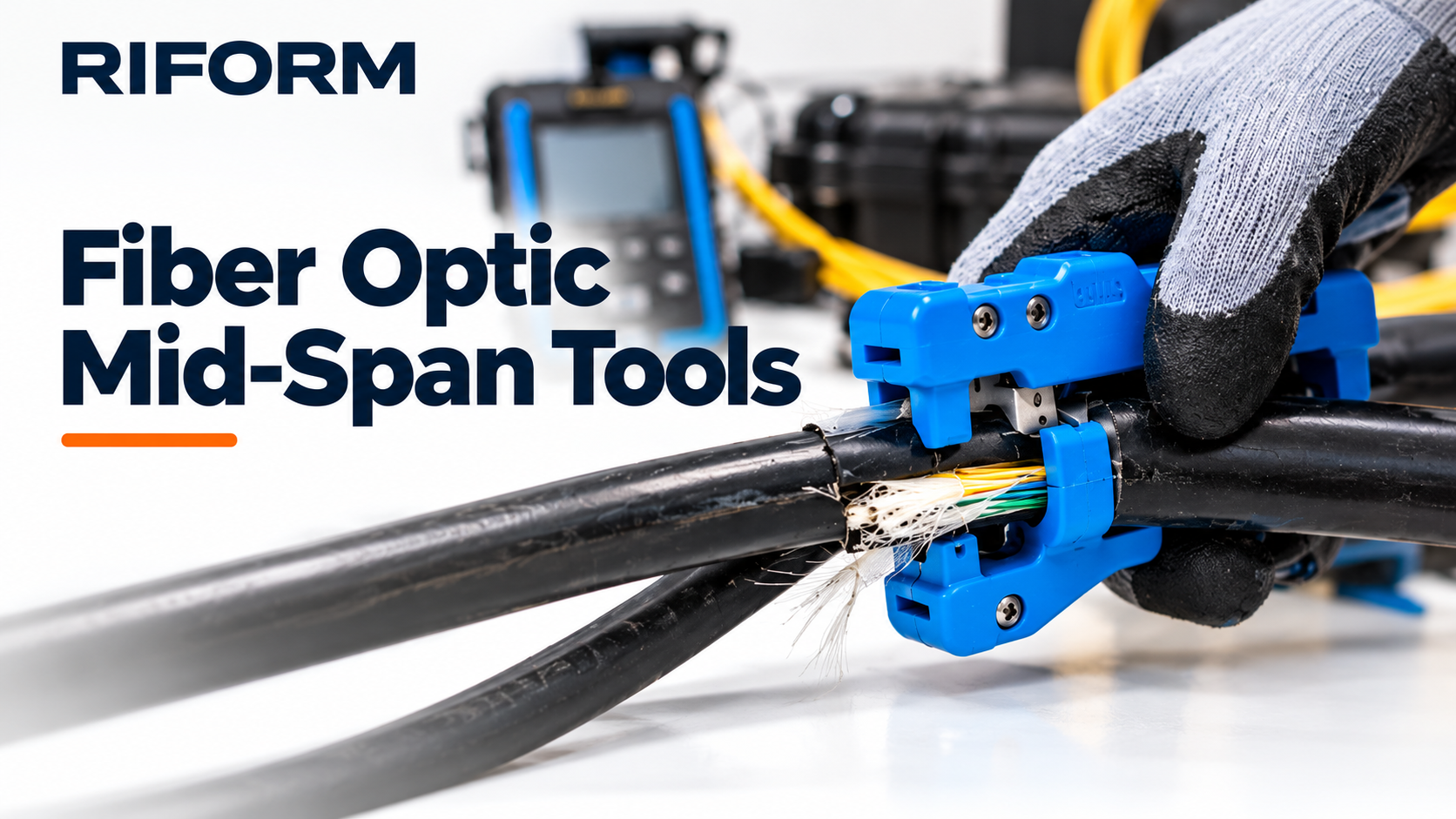
Fiber Optic Mid-Span Slitting Tools: Complete Guide to Jonard MS Series for FTTH Professionals (2026)
Technical Guide | RIFORM – Fiber Optic & Telecom Training | Brussels, Belgium
Fiber optic network installation demands accuracy at every stage, particularly during cable preparation. Whether technicians are working on FTTH deployments, distribution networks, underground installations, or high-density fiber infrastructure, choosing the correct cable-opening tool is essential to maintaining fiber integrity.
Among the specialized equipment available to telecom professionals, the Jonard Tools MS Series Mid-Span Slit & Ring Tools offers a range of solutions for accessing fibers inside optical cables and opening selected microducts.
But what is the difference between the MS-446, MS-526, MS-836, MS-D7, and MS-D12? Which tool should technicians use for different diameters? And why does proper mid-span cable preparation matter?
This technical guide from RIFORM, a professional fiber optic training center in Brussels, Belgium, explains the key tools, applications, selection criteria, and working methods used in modern FTTH infrastructure projects.
What Is a Fiber Optic Mid-Span Slitting Tool?
A mid-span slitting tool is a specialized instrument designed to open a specific section of a fiber optic cable without necessarily cutting the cable completely.
Unlike conventional stripping tools, which generally operate from the cable end, a mid-span tool provides access at an intermediate point along a cable route.
This process is especially useful for technicians who need to access selected fibers at distribution points while preserving the continuity of other fibers.
Two common operations are:
- Longitudinal slitting: Cutting along the length of the cable jacket to expose the internal structure.
- Ring cutting: Making a controlled circumferential cut around the jacket to define the preparation area.
The correct technique depends on the construction of the cable, jacket material, fiber arrangement, and dimensions.
Professional mid-span preparation can be valuable in FTTH distribution enclosures, access networks, fiber branching points, telecommunications maintenance, and infrastructure expansion.
However, the tool must match the cable design. Using an incompatible blade profile, groove, or cutting method can damage internal fibers and lead to expensive rework.
Why Proper Cable Preparation Matters in FTTH Networks
In modern fiber infrastructure, precision cable preparation directly influences installation quality.
A poorly prepared cable may result in:
- Damaged optical fibers or buffer tubes.
- Increased attenuation caused by excessive bending or mechanical stress.
- Delays in cable termination or splicing.
- Additional troubleshooting and corrective work.
- Cable replacement and material waste.
- Increased project costs and potential disruption to network services.
A suitable mid-span tool helps technicians perform more controlled operations, but even high-quality equipment requires the correct technique.
Successful fiber optic preparation depends on three factors: choosing the correct tool, understanding cable construction, and applying an appropriate cutting procedure.
This is why professional preparation practices form an important part of practical FTTH technician training.
Jonard MS Series: Models, Sizes and Applications
Jonard Tools manufactures a broad range of mid-span tools designed for different optical cable and microduct dimensions.
The following comparison helps identify suitable models according to the manufacturer's stated application ranges.
ModelDiameter or sizePrimary applicationMS-3061.2–3.3 mmSmall fiber optic cablesMS-3162.9–6.8 mmSmall and medium cable preparationMS-3265–10 mmFiber optic cable accessMS-3367.9–11 mmMid-sized optical cablesMS-4265.8–12 mmCable slitting and ringingMS-4468.7–14.6 mmMedium and larger optical cablesMS-5269.8–18.2 mmLarger fiber optic cable jacketsMS-83611.6–22.6 mmCompatible RocketRibbon® cablesMS-D77 mm ductMicroduct accessMS-D1010 mm ductMicroduct accessMS-D1212 mm ductMicroduct access
Important: The ranges shown describe manufacturer-supported applications, not universal compatibility with every cable of that diameter. Always verify individual groove dimensions, jacket construction, wall thickness, and cable compatibility.
MS-446: Mid-Span Slitting for 8.7–14.6 mm Cables
The Jonard MS-446 is designed for mid-span access to optical fibers in compatible cables measuring between 8.7 mm and 14.6 mm.
It is used for longitudinal and circumferential jacket preparation, making it relevant for network construction, cable access, and maintenance.
For FTTH installers, it may be considered when dealing with compatible medium-to-large distribution cable jackets.
Before starting work, technicians should verify the relevant cutting groove and test the procedure on suitable sample cable whenever necessary.
MS-526: Cable Preparation for 9.8–18.2 mm
The Jonard MS-526 supports compatible fiber optic cables with diameters from 9.8 mm to 18.2 mm.
Compared with smaller tools in the series, it extends the range available for larger jackets used in fiber distribution and telecommunications infrastructure.
Typical professional applications include opening selected cable sections for branching, maintenance, or access in distribution enclosures.
Technicians should pay particular attention to internal cable elements, including buffer tubes, strength members, and fiber bundles.
MS-836: Mid-Span Access for RocketRibbon® Cables
The Jonard MS-836 is a specialized mid-span tool designed for compatible RocketRibbon® cable constructions.
Its four precision slitting and ringing grooves cover these individual ranges:
- 11.6–12.0 mm
- 14.5–14.9 mm
- 16.8–17.2 mm
- 22.2–22.6 mm
These groove ranges are particularly important because the MS-836 is not a universal tool for every diameter between 11.6 mm and 22.6 mm.
The cable must correspond to one of its supported grooves and compatible constructions.
For contractors working with ribbon-based optical infrastructure, understanding cable design and selecting the correct groove are essential before performing a mid-span operation.
Microduct Slitting: MS-D7, MS-D10 and MS-D12
Modern FTTH deployments frequently rely on microduct infrastructure. These ducts provide protected routes through which optical cables can be installed, often using specialized fiber blowing equipment.
At certain stages of installation or maintenance, technicians may need controlled access to a duct.
The Jonard MS-D tools are intended for specific microduct diameters and cutting requirements.
MS-D7: For 7 mm Microducts
The MS-D7 is designed for compatible 7 mm microducts, with the manufacturer specifying a 3 mm duct wall thickness.
Its slitting and ringing functions can assist technicians performing controlled duct-opening operations.
MS-D10: For 10 mm Microducts
The MS-D10 is designed for compatible 10 mm microducts with a specified wall thickness of 2 mm.
Correct duct identification matters because wall thickness and material can influence cutting behavior.
MS-D12: For 12 mm Microducts
The MS-D12 is intended for compatible 12 mm microducts with a specified 2 mm wall thickness.
It provides longitudinal and ring-cutting functionality for the appropriate duct construction.
Technical distinction: Microduct slitting tools and fiber optic cable jacket slitters are not interchangeable simply because the external dimensions appear similar. One is designed around duct construction, while the other addresses specific cable jackets.
How to Choose the Correct Fiber Optic Slitting Tool
Selecting a professional slitting tool involves more than measuring the approximate external diameter.
Before using any MS Series tool, technicians should evaluate five characteristics.
1. External diameter
Measure the actual cable or duct diameter using suitable measuring equipment. Do not rely exclusively on nominal dimensions printed on packaging.
2. Cable or duct construction
Determine whether the object is a fiber optic cable jacket, buffer tube, ribbon-based construction, or microduct. Each requires an appropriate cutting method.
3. Material and thickness
Wall thickness, jacket hardness, material type, and protective layers all influence the preparation procedure.
4. Required cutting operation
Confirm whether the operation requires longitudinal slitting, ringing, jacket shaving, or another preparation technique.
5. Manufacturer compatibility
Consult the relevant product specifications and cable documentation. Where compatibility is uncertain, perform an approved trial on a non-service sample rather than experimenting on a live installation.
There is no single mid-span tool that suits every FTTH application.
For contractors managing multiple cable types, a carefully selected combination of tools may be more practical than relying on one model.
Professional Mid-Span Preparation: Recommended Workflow
A structured workflow helps reduce avoidable cable damage and inconsistent preparation.
Step 1: Identify the cable
Confirm the cable construction, outside diameter, jacket material, internal elements, and manufacturer requirements.
If working on an active network, complete the required identification, authorization, and network-protection procedures first.
Step 2: Inspect the tool
Check the slitting grooves, cutting components, and general condition. Worn or damaged blades should be replaced according to the manufacturer's instructions.
Step 3: Determine the access length
Identify the intended preparation section based on the enclosure design, installation requirements, and applicable bend-radius limits.
Step 4: Perform the cut
Position the approved tool correctly and follow its specified procedure. Avoid excessive force, twisting, or uncontrolled blade movement.
Step 5: Open the jacket carefully
Remove the prepared section while protecting internal fiber units, strength members, and other cable components.
Step 6: Inspect the result
Look for visible signs of jacket damage, compressed buffer tubes, exposed or stressed fibers, and other defects.
Proceed with further preparation and testing only when the cable condition meets project requirements.
Safety note: Mid-span preparation of an active optical network requires suitable training, work authorization, and optical safety precautions. Technicians must never look into unidentified fibers or connectors.
Common Mistakes During Fiber Optic Cable Preparation
Even experienced technicians can encounter problems when cable dimensions or structures vary between manufacturers.
Typical mistakes include:
- Choosing a groove using the nominal rather than measured diameter.
- Confusing microduct-opening equipment with cable-jacket tools.
- Applying unnecessary cutting pressure.
- Ignoring internal strength members.
- Using worn cutting components.
- Opening longer cable sections than the enclosure requires.
- Failing to inspect the fiber elements after jacket removal.
A standardized cable-preparation procedure, supported by practical training and cable-specific documentation, can help teams minimize these risks.
Mid-Span Slitting, Fusion Splicing and OTDR Testing: How They Connect
Cable preparation is only one part of a successful fiber optic installation.
After exposing and preparing the required fiber elements, technicians may need to complete fusion splicing, fiber management, connector inspection, and optical testing.
Each activity contributes to overall network reliability.
Cable preparation establishes access to the required fibers while protecting the remaining cable structure.
Fusion splicing creates a permanent optical connection between appropriately prepared fiber ends.
Optical inspection and testing help verify workmanship and identify potential connection or transmission problems.
OTDR measurements, where appropriate, help technicians investigate optical events, losses, and network faults.
Combining these skills allows professionals to understand the entire installation process rather than treating cable opening, splicing, and testing as isolated activities.
Professional FTTH and Cable Preparation Training in Belgium
Knowing how to select a slitting tool is useful, but field performance also depends on practical experience.
Technicians should be able to recognize cable structures, select equipment, inspect preparation results, and work within the specifications of the network being installed.
At RIFORM in Brussels, Belgium, fiber optic training focuses on practical technical skills used in modern telecommunications infrastructure.
Relevant training areas include:
- Fiber optic fundamentals and cable construction.
- FTTH cable preparation and stripping.
- Fusion splicing and fiber management.
- OTDR testing and fault diagnostics.
- Fiber blowing and microduct deployment.
- Technical procedures and equipment handling.
Training on specific MS Series products should be confirmed as part of the requested program scope.
Training for Contractors and Installation Companies
For telecommunications contractors, cable preparation is also a matter of operational consistency.
When different technicians apply different methods to the same infrastructure, installation results can become inconsistent.
Structured company training can help standardize procedures, improve tool selection practices, and address recurring field issues.
RIFORM offers corporate training solutions for companies seeking practical programs adapted to their technical activities.
Training may be arranged around specific subjects, team requirements, and relevant installation scenarios.
For companies managing FTTH projects across Belgium, this provides a way to develop technical skills within an organized training framework.
Frequently Asked Questions About MS Series Tools
What is the purpose of a mid-span fiber optic tool?
A mid-span tool allows technicians to open a selected section of a compatible optical cable jacket without necessarily cutting the entire cable at that location. It is useful for distribution access, branching operations, and maintenance.
What is the difference between the MS-446 and MS-526?
The MS-446 covers compatible cable diameters from 8.7 mm to 14.6 mm, while the MS-526 covers 9.8 mm to 18.2 mm. Exact compatibility depends on the supported grooves and cable construction.
Can the MS-836 be used on all 11.6–22.6 mm cables?
No. The MS-836 is designed for compatible RocketRibbon® cables and uses four defined groove ranges. Its overall diameter range does not indicate universal compatibility.
Can I use the MS-D12 to open a fiber optic cable jacket?
The MS-D12 is designed for compatible 12 mm microducts with the specified wall thickness, not as a general-purpose cable jacket slitter.
Which tools are needed for professional FTTH installation?
Depending on the project, technicians may require cable and microduct preparation tools, fiber strippers, cleavers, fusion splicers, connector cleaning tools, optical power meters, inspection equipment, and OTDR instruments. Selection depends on the network architecture and work scope.
Where can technicians learn fiber optic cable preparation in Belgium?
RIFORM provides practical fiber optic and telecommunications training in Brussels, including cable preparation, fusion splicing, optical testing, and FTTH deployment-related disciplines.
Can companies organize training for an entire installation team?
Yes. RIFORM offers customized corporate training arrangements intended for telecom contractors, subcontractors, and organizations that need structured technical development.
Conclusion: Precision Begins Before Splicing
Successful FTTH installation depends on precision from the first preparation operation to the final optical measurement.
Jonard MS Series tools offer specialized options for mid-span cable and microduct access, but effective results require appropriate equipment selection and a clear understanding of the underlying cable structure.
For technicians, mastering these procedures is an important part of developing reliable field skills.
For telecom contractors and infrastructure companies, consistent preparation practices can support better workmanship and reduce avoidable installation problems.
Develop your technical capabilities with RIFORM.
Whether you are an individual technician learning professional fiber optic installation or a company developing an FTTH team, RIFORM provides practical training focused on real technical applications.
Explore training programs or request a customized corporate training proposal.
RIFORM – Professional Fiber Optic & Telecom Training
Brussels, Belgium
Website: https://www.riform.be
Email: contact@riform.be
Phone: +32 470 70 76 01
Build technical knowledge. Develop practical skills. Improve installation quality.