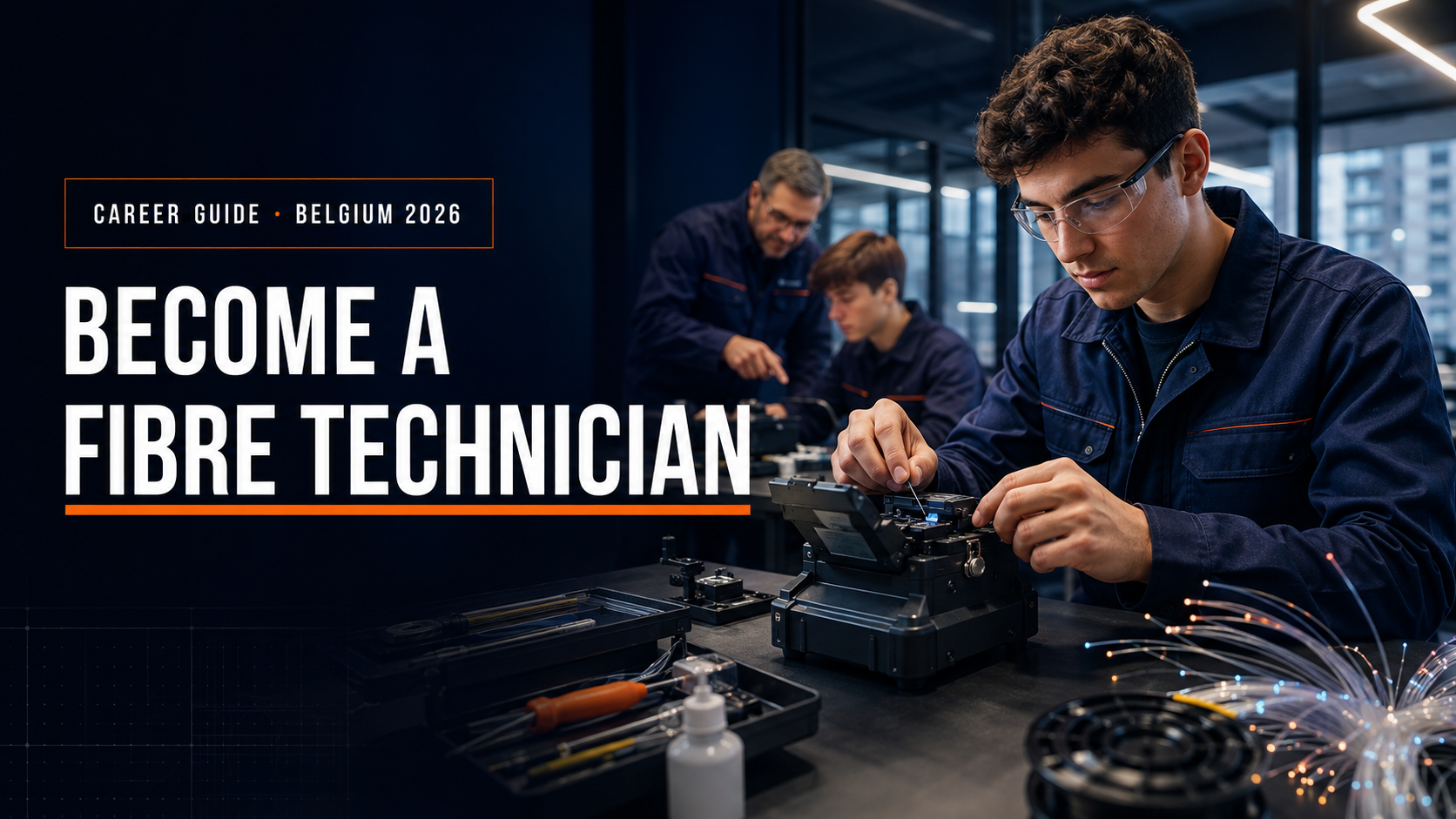
How to Become a Fibre Optic Technician in Belgium in 2026–2027
Belgium's fibre network is continuing to expand, creating opportunities for technicians who know how to install, splice, test and troubleshoot fibre-optic networks.
As of the end of June 2026, Proximus reported that approximately 2.753 million homes and businesses were passed by its fibre network, while additional deployment continues through Proximus, Fiberklaar, Wyre and other infrastructure partners.
At the same time, the European Commission's 2026 Digital Decade report says Belgium still faces challenges in fibre deployment and shortages of ICT specialists.
For someone looking for a practical technical career, 2026–2027 is therefore an interesting time to develop professional fibre-optic skills.
But how do you actually become a fibre optic technician in Belgium?
This guide explains the practical route.
What Does a Fibre Optic Technician Do?
A fibre optic technician installs, maintains, tests and repairs optical-fibre networks.
Depending on the company and project, technicians may work on:
FTTH – Fibre to the Home, connecting homes and apartments to fibre networks.
FTTB – Fibre to the Building, installing fibre infrastructure inside commercial or residential buildings.
Telecom infrastructure, including street cabinets, distribution points and underground fibre networks.
Data centres and enterprise networks, where fibre is used for high-speed communication between switches, racks and network equipment.
In practice, fibre technicians can perform work such as:
- fibre cable preparation
- cable stripping
- mid-span cable access
- fibre cleaning
- precision fibre cleaving
- fusion splicing
- splice protection
- fibre management in trays
- installation of pigtails and connectors
- optical power measurements
- OTDR testing
- fault localisation
- interpreting fibre diagrams
- documenting installations
The profession combines precision work, technical knowledge and practical field experience.
Step 1: Learn the Fundamentals of Fibre Optics
Before using a fusion splicer, it is important to understand what is actually happening inside the cable.
A beginner should understand topics such as:
Single-mode vs multimode fibre
Most telecom and FTTH networks use single-mode fibre, while multimode fibre is commonly encountered in shorter-distance enterprise and data-centre installations.
Fibre structure
You should understand:
Core → Cladding → Coating → Buffer → Cable protection
Understanding cable construction becomes especially important when working with loose-tube, micro-cable and high-fibre-count cables.
Optical loss
Technicians also need to understand why fibre signals lose power.
Typical causes include:
- dirty connectors
- bad splices
- macro-bending
- micro-bending
- damaged fibre
- poor connector installation
- excessive distance
Knowing these principles makes troubleshooting significantly easier later.
Step 2: Learn Fibre Cable Preparation
Before fibre can be spliced, it must be prepared correctly.
Professional fibre preparation can involve several specialised tools.
You may encounter:
Cable slitters – used to open fibre cable jackets.
Mid-span access tools – used to access fibres without cutting the entire cable.
Buffer tube strippers – used to remove protective tubes.
Fibre strippers – used to remove the coating around individual fibres.
Kevlar scissors – used to cut aramid reinforcement fibres.
Cable preparation is one of the first areas where beginners need hands-on practice.
Incorrect stripping can damage fibres before they even reach the splicing machine.
Step 3: Learn Precision Fibre Cleaving
After stripping the fibre, the glass must be cut extremely accurately.
This process is called cleaving.
A fibre cleaver creates a flat end face so that two fibres can be aligned and fusion-spliced together.
Professional technicians should learn how to:
- correctly position the fibre
- maintain the correct cleave length
- inspect cleave quality
- clean the cleaver
- rotate or replace the cleaving blade
- recognise poor cleaves
A high-quality fusion splicer cannot compensate for badly prepared fibre.
Good splicing starts with good fibre preparation and good cleaving.
Step 4: Learn Fusion Splicing
Fusion splicing is one of the most important skills for a fibre technician.
A fusion splicer aligns two fibres and uses an electrical arc to permanently fuse them together.
Modern machines make the process much easier, but the technician still needs to understand how to prepare and operate the equipment correctly.
You should learn:
- stripping
- cleaning
- cleaving
- positioning fibres
- fibre alignment
- fusion splicing
- splice-loss evaluation
- installing the splice protector
- organising the fibre inside the splice tray
Repeated hands-on practice is important.
Doing three successful splices is not the same as being able to complete an entire fibre enclosure efficiently in the field.
A technician should become comfortable making consistent, repeatable splices.
Step 5: Learn How to Work With Fibre Closures and Trays
A technician does much more than simply operate a fusion splicer.
You must also understand fibre management.
That means learning how to organise fibres inside:
- splice closures
- distribution boxes
- FTTH termination boxes
- patch panels
- fibre trays
- optical distribution frames
Poor fibre management can create unnecessary bends, stress or future maintenance problems.
A professional installation should remain understandable to the next technician who opens the enclosure.
Step 6: Learn Fibre Testing
Installing fibre is only part of the job.
You also need to prove that the connection works correctly.
Two important testing methods are:
Optical Power Meter
A power meter measures the optical signal level.
It is commonly used together with an optical light source to calculate link loss.
OTDR
An Optical Time Domain Reflectometer sends optical pulses through the fibre and analyses the reflections.
It can help technicians identify:
- fibre length
- splices
- connectors
- excessive losses
- fibre breaks
- bending events
- reflectance events
Learning to read an OTDR trace is an important step between becoming a basic installer and becoming a more advanced fibre technician.
Step 7: Learn Connector Inspection and Cleaning
A surprisingly large number of fibre problems originate from contamination.
Dust that looks microscopic to us can be huge compared with the fibre core.
Professional technicians therefore follow a simple principle:
Inspect → Clean → Inspect → Connect
You should know how to use:
- fibre inspection microscopes
- one-click cleaners
- lint-free wipes
- fibre cleaning fluid
- cleaning sticks
- connector cleaners
Never assume that a new connector is automatically clean.
Step 8: Get Practical Fibre Optic Training
You can learn fibre theory online, but fibre installation is fundamentally a hands-on profession.
A good practical fibre optic training course should allow you to physically work with the equipment.
Look for training that covers:
- fibre fundamentals
- cable preparation
- stripping
- cleaning
- cleaving
- fusion splicing
- splice trays
- fibre closures
- connectors
- optical power measurement
- OTDR testing
- troubleshooting
In Flanders, VDAB offers a wide range of recognised technical vocational training programmes, including practical learning and programmes linked to occupations where employers are looking for workers.
Depending on your situation, you can also find technical training through private training providers, employers and specialist telecom companies.
Fibre Optic Training With RIFORM in Belgium
For technicians who want practical experience with real fibre equipment, RIFORM provides professional fibre optic training and technical equipment for the Belgian market.
The objective is not simply to explain fibre from a presentation.
Participants should become comfortable handling the tools used during actual installations.
Training can include practical work with:
Fusion splicers
Learn fibre preparation, cleaving, fusion splicing and splice protection.
Fibre cleavers
Learn how to create clean and consistent fibre end faces.
OTDR equipment
Understand basic measurements, events, attenuation and fault localisation.
Fibre preparation tools
Learn safe and efficient cable opening, stripping and mid-span access.
Fibre cleaning equipment
Learn professional cleaning procedures before connection and testing.
For companies, training can also be useful when onboarding new technicians or standardising installation procedures across a team.
What Tools Does a Beginner Fibre Technician Need?
You do not necessarily need to purchase an entire professional laboratory on your first day.
A sensible starter toolkit can include:
EquipmentPurposeFibre stripperRemove fibre coatingFibre cleaverPrecision-cut fibreKevlar scissorsCut reinforcement fibresFibre cleaning kitClean fibre and connectorsVisual Fault LocatorBasic fibre continuity checksFusion splicerJoin optical fibresSplice protectorsProtect completed fusion splicesCable preparation toolsOpen and prepare fibre cablesPower meterMeasure optical powerLight sourceTest optical loss
As you become more advanced, you can add equipment such as an OTDR, inspection microscope, launch cable and specialised mid-span tools.
Which Fusion Splicer Should You Learn On?
In Belgium, technicians encounter multiple professional splicing systems.
Common professional manufacturers include brands such as:
- Sumitomo Electric
- Fujikura
- INNO Instrument
- Furukawa / FITEL
The most important thing for a beginner is not simply learning which button to press.
You should understand the complete workflow around the machine.
For example:
Cable → Strip → Clean → Cleave → Splice → Protect → Organise → Test
If you understand this process, adapting to another professional fusion splicer becomes significantly easier.
Do You Need a Diploma to Become a Fibre Optic Technician in Belgium?
There is not one universal route that every fibre technician in Belgium must follow.
People enter the industry through different pathways, including:
- telecom training
- electrical studies
- network installation
- employer training
- vocational education
- private fibre training
- apprenticeship or workplace learning
Employers and projects may also impose their own requirements.
Depending on the type of worksite, additional safety training or certifications may be requested.
Always check the requirements of the specific employer or contractor before starting work.
Do You Need VCA?
For many technicians working on construction or infrastructure sites in Belgium, VCA safety training can be relevant or required by the company or project.
However, VCA should not be confused with fibre-optic technical certification.
VCA focuses primarily on workplace safety.
Fibre training focuses on skills such as:
- cable preparation
- splicing
- testing
- installation
They complement each other but serve different purposes.
Dutch or French: Does Language Matter?
Belgium's telecom market operates across several linguistic regions.
In Flanders, Dutch is frequently the working language.
In Wallonia, French is commonly required.
In Brussels, technicians may encounter French, Dutch and English depending on the company and project.
You do not necessarily need perfect language skills to start learning fibre technology, but being able to communicate with supervisors, colleagues and customers can significantly increase your employment opportunities.
Can You Become a Fibre Technician Without Previous Experience?
Yes.
You do not need to begin as a telecom expert.
Many of the basic fibre skills can be learned progressively.
A good beginner progression is:
Week 1: Learn fibre theory and safety.
Week 2: Practise stripping and cleaning fibre.
Week 3: Practise cleaving.
Week 4: Perform repeated fusion splices.
Next: Learn closures, fibre management and FTTH installation.
Then: Learn power measurement and OTDR testing.
Finally: Gain field experience alongside an experienced technician.
The key is repetition.
Fibre work requires precision that comes from physically handling fibre, not simply watching videos.
How Long Does It Take to Learn Fibre Splicing?
The basic process can be learned relatively quickly.
Becoming a competent field technician takes longer.
There is an important difference between:
knowing how to make a splice
and
being able to prepare, splice, organise, test and troubleshoot an entire fibre installation professionally.
For this reason, combine technical training with as much practical work as possible.
Are Fibre Optic Technicians in Demand in Belgium?
Belgium continues to invest heavily in fibre infrastructure.
Proximus reported more than 2.75 million fibre-connectable homes and businesses by June 2026, while its broader deployment plans continue in Flanders, Wallonia, Brussels and the German-speaking Community.
In July 2026, Proximus, Fiberklaar, Telenet and Wyre also announced implementation of their cooperation for further fibre deployment in Flanders, including commitments covering more than two million fibre-connectable homes and businesses in designated areas over the coming years.
This means the Belgian fibre market is not limited to initial cable deployment.
Networks also require technicians for:
- customer connections
- maintenance
- repairs
- testing
- network upgrades
- business installations
- troubleshooting
Fibre Technician Career Paths
Once you have experience, fibre optics can lead to several technical roles.
You might start as a:
FTTH Installer
and progress toward:
Fibre Splicer
then:
Fibre Testing Technician
or:
OTDR / Network Troubleshooting Technician
and later move toward positions such as:
Team Leader
Site Supervisor
Fibre Network Specialist
Telecom Project Technician
or start operating as an independent subcontractor.
Employee or Independent Fibre Technician?
Both models exist in Belgium.
Employee
Working for a telecom contractor can be a good way to gain structured experience.
The company may provide:
- vehicle
- equipment
- projects
- training
- supervision
Independent technician
Experienced technicians may later decide to work as subcontractors.
In that case you may need to invest in:
- fusion splicer
- cleaver
- OTDR
- testing equipment
- preparation tools
- vehicle
- safety equipment
- insurance
- administration
For beginners, experience and technical competence should come before investing heavily in equipment.
The Ideal Fibre Technician Skill Set for 2027
A technician who wants to remain competitive should aim to understand the complete fibre workflow.
That includes:
Preparation
Cable opening, stripping and fibre identification.
Splicing
Fast and consistent fusion splicing.
Fibre management
Correct tray and enclosure organisation.
Testing
Power measurements and OTDR analysis.
Troubleshooting
Finding breaks, bad splices, contamination and bending losses.
Documentation
Recording results and correctly identifying fibres.
Safety
Working responsibly on telecom and construction sites.
A technician who can only splice fibres is useful.
A technician who can install, splice, test, diagnose and document the complete link offers a much broader technical skill set.
Start Your Fibre Optic Career With RIFORM
If you want to enter the fibre-optic industry in Belgium, the best first step is practical training.
At RIFORM, we help technicians and telecom companies develop practical fibre skills using professional equipment.
Whether you are:
- completely new to fibre
- an electrician moving into telecom
- starting an FTTH job
- building your own fibre installation company
- training new employees
- improving your splicing and OTDR skills
our goal is to help you move from theory to real fibre work.
Fibre Optic Training in Belgium
Learn:
Cable preparation → Fibre stripping → Cleaving → Fusion splicing → Fibre management → Testing → OTDR
You can also find professional fibre-optic equipment, splicing machines, preparation tools and testing equipment through RIFORM.
Ready to Start?
Contact RIFORM for fibre optic training in Belgium or advice on choosing your first professional fibre toolkit.
RIFORM – Fibre Optic Equipment, Training & Technical Solutions in Belgium
FAQ
How do I become a fibre optic technician in Belgium?
Start by learning fibre fundamentals, cable preparation, cleaving and fusion splicing. Continue with fibre management, optical testing and OTDR troubleshooting, then gain practical field experience.
Can I become a fibre technician without experience?
Yes. Fibre optics can be learned from beginner level, but hands-on practice is essential.
Do I need a diploma?
There is no single educational route used by every fibre technician. Requirements vary between employers and projects.
Is fibre optic training difficult?
The theory is relatively straightforward for most beginners. The greater challenge is developing the precision and speed required for field installations.
Should I learn OTDR testing?
Yes. OTDR knowledge becomes particularly valuable if you want to move beyond basic installations into troubleshooting and advanced fibre work.
Where can I learn fibre optic splicing in Belgium?
Training is available through vocational and private technical training providers. RIFORM also provides practical fibre-optic training focused on professional installation, fusion splicing and testing.
Is fibre optics a useful career for 2026–2027?
Belgium's fibre rollout is still expanding substantially, while EU reporting continues to identify fibre deployment and ICT skills availability as areas requiring further development.
What equipment should a beginner fibre technician learn?
Start with fibre strippers, cleaning tools, a fibre cleaver and fusion splicer. Then progress toward optical power meters, inspection equipment and OTDR testing.