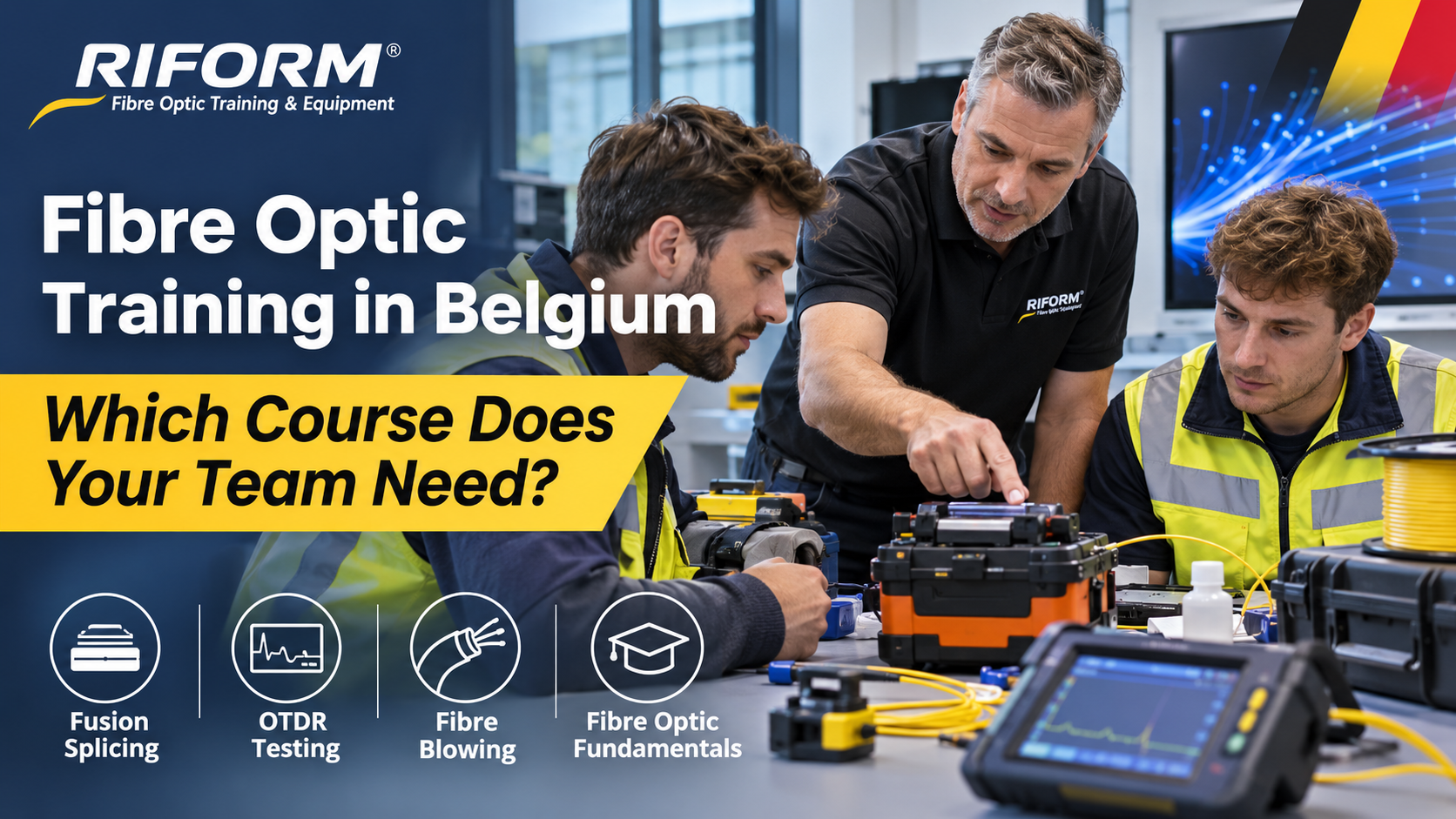
Fibre Optic Training in Belgium: Which Course Does Your Team Actually Need?
A fibre-optic installation team can have excellent equipment and still lose valuable time because of inconsistent preparation, incorrect splicing techniques or poor test interpretation.
For telecom contractors and infrastructure companies, professional training is not simply about learning how fibre optics work. It is about developing practical skills that technicians can apply confidently on real projects.
But which fibre-optic training should your team choose?
Should technicians start with the fundamentals? Focus on fusion splicing? Learn OTDR testing? Or develop the skills required for fibre blowing and microduct deployment?
The right answer depends on the work your team performs.
At RIFORM in Brussels, Belgium, practical fibre-optic training is designed around the technical skills used in professional telecom infrastructure work.
1. Fibre Optic Fundamentals: Building the Right Foundation
Before technicians begin working with fusion splicers or optical test equipment, they need to understand the fundamentals.
This includes optical fibre construction, cable types, connectors, network architectures and the main causes of signal loss.
A good foundation helps technicians understand not only what to do, but why each step matters.
For example, improper handling can introduce microbending or macrobending losses. Poor connector cleaning can increase insertion loss and reflectance. Incorrect cable preparation can damage the fibre before splicing even begins.
Who needs this training?
Fibre fundamentals are especially relevant for new telecom technicians, contractors entering FTTH projects and companies expanding into optical infrastructure.
The objective is to establish safe, consistent working habits before moving into specialist tasks.
2. Fusion Splicing Training: Improving Installation Quality
Fusion splicing is a critical skill in fibre-optic installation.
Modern fusion splicers automate important parts of the process, but the quality of a splice still depends on the technician.
Poor stripping, contaminated fibre, incorrect cleaving or inadequate maintenance can all affect the result.
Professional fusion-splicing training should therefore include practical work with:
- Fibre preparation and stripping
- Cleaning and cleaving
- Fusion-splicer operation
- Splice protection
- Common splice defects
- Equipment maintenance
- Splice-quality assessment
Technicians should understand that a fusion splicer's estimated loss is not a substitute for appropriate link testing.
Who needs this training?
FTTH installers, fibre jointers, maintenance teams and technicians responsible for optical connections.
For companies purchasing new fusion splicers, training can also help standardise procedures across the team.
3. OTDR Training: Understanding What the Trace Really Means
An Optical Time-Domain Reflectometer, or OTDR, is a powerful diagnostic instrument.
However, owning an OTDR does not automatically mean a technician can interpret its results correctly.
An OTDR trace may contain events associated with connectors, splices, bends, reflections or fibre breaks. Understanding the difference requires practical knowledge.
Effective OTDR training should cover:
- Wavelength selection
- Pulse width and measurement range
- Launch and receive fibres
- Event dead zones
- Reflective and non-reflective events
- Attenuation and splice-loss interpretation
- Fault localisation
- Test reporting
The most valuable exercises involve realistic fault scenarios, not only perfect laboratory links.
Who needs this training?
Installation technicians, network maintenance teams, test engineers and contractors responsible for acceptance testing or troubleshooting.
4. Fibre Blowing Training: More Than Operating a Machine
Fibre blowing is widely used in modern FTTH and telecom infrastructure deployment.
A successful installation depends on several interacting factors: cable characteristics, duct condition, route geometry, airflow, pressure, pushing force and operator technique.
A fibre-blowing machine is only one component of the installation system.
Technicians must understand how to prepare ducts, select suitable equipment, monitor installation conditions and recognise problems before cable damage occurs.
Who needs this training?
FTTH deployment contractors, microduct installation teams and infrastructure companies introducing or expanding cable-blowing operations.
For employers, practical training can be especially valuable when introducing unfamiliar equipment or standardising installation procedures.
5. How to Choose the Right Training for Your Company
Start by identifying the work your technicians must perform.
A new installation team may need a foundation course followed by fusion-splicing practice.
An experienced splicing team may benefit more from OTDR testing and fault diagnosis.
A contractor moving into microduct deployment may need specialised fibre-blowing training.
Before booking, consider four questions:
What tasks must technicians perform independently?
Which errors or delays occur most often on your projects?
What equipment does the team currently use?
What practical competence should participants demonstrate after training?
These questions help identify the right training path without investing time in unnecessary modules.
6. Why Practical Training Matters
A presentation can explain how a fusion splicer works.
Hands-on training allows technicians to prepare fibres, make mistakes, correct them and repeat the process until their technique becomes consistent.
The same principle applies to OTDR interpretation and fibre blowing.
Practical exercises connect technical theory to decisions made on site.
For employers, this creates an opportunity to develop shared procedures and identify skill gaps before they affect project delivery.
Fibre Optic Training in Brussels with RIFORM
RIFORM provides professional training focused on fibre optics and telecom infrastructure, including practical learning in fusion splicing, OTDR testing and fibre blowing.
Whether you are developing one technician or preparing a complete installation team, the most useful starting point is understanding your project requirements.
Prepare Your Team for Its Next Fibre Project
Tell RIFORM what your technicians need to do, how many people require training and which equipment they use.
We can discuss a suitable training pathway based on your technical objectives.
Explore RIFORM Professional Training
RIFORM — Professional Fibre Optic Training & Equipment, Brussels, Belgium
Frequently Asked Questions
Where can I find fibre-optic training in Belgium?
RIFORM provides professional fibre-optic and telecom-infrastructure training in Brussels, Belgium.
Is fusion-splicing training suitable for beginners?
Technicians new to fibre work should first understand basic fibre handling and preparation. The appropriate course depends on their existing experience and the programme prerequisites.
Do technicians need OTDR training?
Technicians responsible for optical testing, acceptance measurements or fault diagnosis benefit from learning how to configure an OTDR and interpret its traces correctly.
Can companies arrange training for several technicians?
RIFORM offers training for professional teams. Contact RIFORM to discuss participant numbers, technical requirements, language and scheduling.