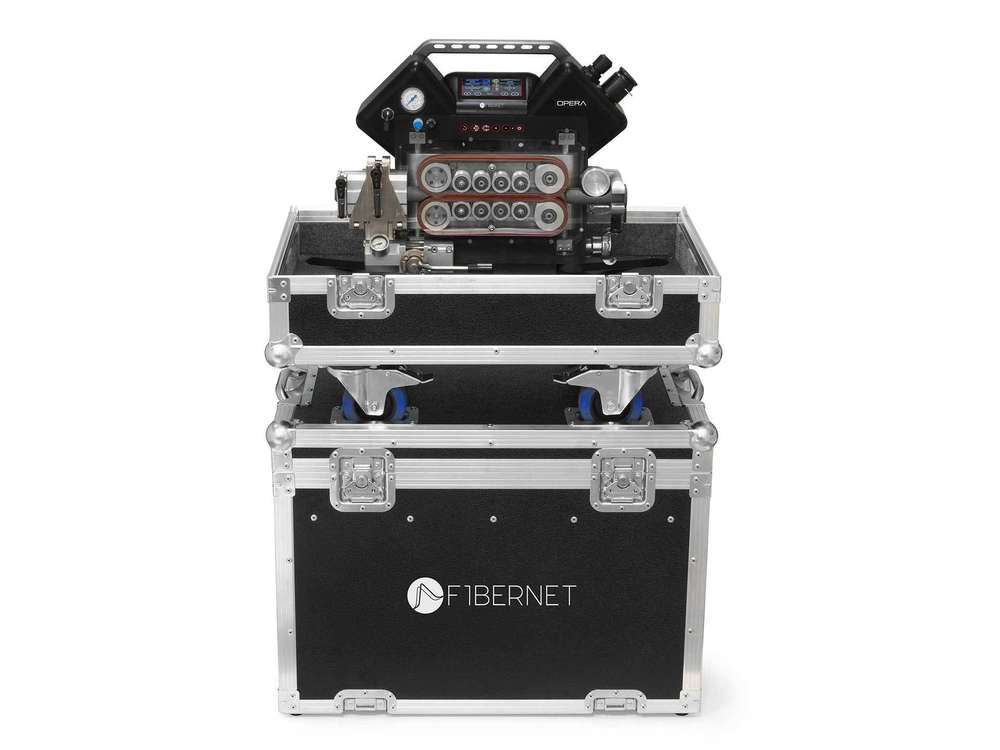
OPERA Fibre Blowing Machine: Professional Guide for FTTH Installers in Belgium
For professional FTTH contractors, telecom installers and infrastructure companies, fibre blowing performance directly affects installation time, cable safety and project profitability.
Long cable routes, changing duct conditions, bends, incorrect airflow and excessive pushing force can quickly turn a normal installation into an expensive problem.
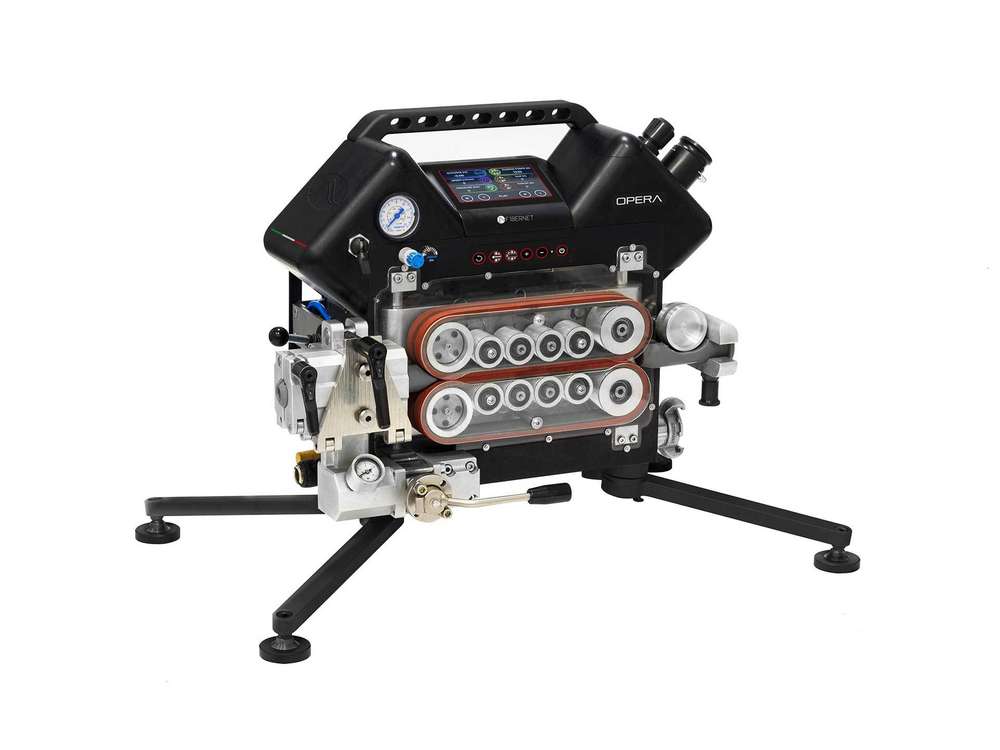
The Fibernet OPERA fibre blowing machine is designed for professional installation of fibre-optic cables into ducts and microduct systems. It combines pneumatic cable propulsion, a double-belt drive system, electronic monitoring and automatic cable protection.
For Belgian contractors working on FTTH, backbone, industrial and telecom infrastructure projects, it provides a controlled solution for demanding cable-blowing operations.
What Is the OPERA Fibre Blowing Machine?
OPERA is a professional pneumatic fibre cable blowing machine developed and manufactured by Fibernet in Italy.
Instead of relying on compressed air alone, the machine combines airflow through the duct with mechanically controlled belt traction.
This allows the installer to control how the cable enters the duct while monitoring important installation parameters directly from the machine.
The integrated display provides information such as:
Installed distance
Cable speed
Air pressure
Pushing force
Cable clamping force
Cable slip
If configured installation limits are exceeded, the protection system can automatically stop the machine.
For contractors installing expensive fibre cables over significant distances, this additional control can help reduce the risk of cable damage and unnecessary rework.
OPERA Technical Specifications
The pneumatic OPERA offers:
Cable diameter: approximately 4–16 mm
Duct diameter: approximately 7–50 mm depending on adapter configuration
Maximum laying speed: 110 m/min
Recommended working speed: around 60 m/min
Maximum pushing force: 900 N
Maximum clamping force: 3,200 N
Maximum air pressure: 16 bar
Recommended compressor: minimum approximately 1,000 L/min at 15 bar
Machine weight: approximately 25 kg
Drive: pneumatic double-belt system
Correct adapters, cable guides, seals and duct clamps must always be selected according to the actual cable and duct dimensions.
Why Professional FTTH Contractors Use Fibre Blowing Machines
On large telecom projects, productivity is not simply about installing cable faster.
Contractors also need repeatability, cable protection, accurate settings and predictable installation results.
The OPERA addresses these requirements through controlled pushing force and continuous monitoring.
Up to 900 N of Controlled Pushing Force
The machine can provide up to 900 N of pushing force.
This makes it suitable for demanding fibre deployment projects where longer duct sections or higher resistance may be encountered.
The maximum force should never automatically be used.
Every fibre cable has mechanical limits specified by its manufacturer. The machine should therefore be configured according to the cable being installed.
Automatic Cable Protection
One of the most important OPERA functions is its integrated cable-protection system.
During installation, sensors monitor operating parameters.
When configured limits are exceeded, the machine can stop automatically.
For professional contractors, this is important because damaging a fibre cable can involve considerably more than the cost of replacing the cable.
It can mean additional technicians, interrupted civil works, duct access, project delays and penalties.
Controlled installation therefore has a direct operational and financial value.
Double-Belt Cable Drive
OPERA uses two belts to push the fibre cable.
The contact area distributes force along the cable instead of concentrating pressure at one small point.
Correct belt adjustment provides traction while helping protect the cable jacket.
The machine also allows the technician to monitor clamping pressure and cable slip during installation.
Real-Time Installation Monitoring
Professional fibre blowing should not be performed blindly.
Resistance can change as the cable travels further through the duct.
Changes may be caused by:
Duct bends
Water or contamination
Duct deformation
Connector problems
Insufficient airflow
Cable friction
Incorrect lubrication
Temperature changes
By monitoring speed, pressure, pushing force and slip, the technician has more information available to identify problems before the installation fails.
The Compressor Is Just as Important as the Blowing Machine
A common mistake is selecting a compressor based only on maximum pressure.
Fibre blowing needs both pressure and sufficient air volume.
For the pneumatic OPERA, approximately 1,000 L/min at 15 bar is recommended as a minimum configuration.
Actual requirements can depend on cable diameter, duct size, distance, bends and installation conditions.
The complete setup should also consider air-hose diameter, moisture separation and air temperature.
For demanding installations, an aftercooler and moisture separator can be important components of the system.
Before Blowing Fibre: Prepare the Duct
Professional equipment cannot compensate for a badly prepared route.
Before beginning installation, the duct should be inspected, tested, cleaned and dried when required.
Technicians should also verify cable diameter, duct dimensions, connectors, seals, compressor capacity and the cable manufacturer's maximum permitted mechanical forces.
A few minutes spent preparing the installation can prevent hours of troubleshooting later.
OPERA for Belgian FTTH and Telecom Contractors
Belgium continues to require significant fibre infrastructure work across residential FTTH, enterprise networks, industrial installations and telecom backbone projects.
For contractors, the choice of fibre blowing equipment should therefore be considered as an operational investment rather than simply a machine purchase.
The correct system should match:
Your typical cable diameters
Microduct and duct sizes
Average installation distances
Available compressor capacity
Number of installation teams
Project volume
Required installation documentation
RIFORM supports professional fibre installers and telecom companies in Belgium with fibre installation equipment and technical guidance.
Buying a Fibre Blowing Machine in Belgium
When purchasing professional cable blowing equipment, comparing only price can be misleading.
A contractor should also consider machine capacity, available adapters, consumables, technical support, training, compatibility with existing compressors and the type of projects the equipment will be used for.
RIFORM can help companies evaluate the complete configuration before purchasing.
This is particularly useful for companies investing in their first professional fibre blowing system or expanding a deployment team.
Fibre Blowing Training in Belgium
Even an advanced blowing machine produces poor results if it is incorrectly configured.
RIFORM provides practical Fibre Blowing & Micro-Duct Deployment training in Brussels for professional technicians, contractors and telecom teams.
Training focuses on real installation workflows, including machine preparation, compressor configuration, duct testing, cable compatibility, blowing parameters, cable protection and troubleshooting.
Participants work with professional fibre installation equipment and practical deployment configurations.
Corporate and team training can also be organised according to operational requirements.
Equipment + Training for Professional Teams
For companies building or expanding an FTTH installation team, purchasing equipment and training technicians together can provide a more structured deployment process.
RIFORM can support professional companies with:
Fibre blowing machines and accessories
Microduct installation equipment
Cable preparation tools
Compressor configuration guidance
Practical fibre blowing training
Fusion splicing training
OTDR testing and diagnostics training
Technical equipment selection
Request a Professional OPERA Configuration
If you are considering an OPERA fibre blowing machine, the correct configuration depends on your project.
Send RIFORM your typical:
Cable diameter
Duct or microduct dimensions
Expected blowing distance
Compressor specifications
Type of fibre deployment
Our team can help identify the suitable machine configuration, adapters and accessories for your application.
OPERA Fibre Blowing Machine & Professional FTTH Equipment in Belgium
RIFORM BV/SRL
Avenue du Marly 15/4
1120 Brussels, Belgium
Tel: +32 470 70 76 01
Email: contact@riform.be
Contact RIFORM for a professional quotation, fibre blowing equipment configuration or practical training program.
Frequently Asked Questions
What is a fibre blowing machine?
A fibre blowing machine uses controlled mechanical pushing force together with compressed air to install fibre-optic cable through ducts or microducts.
How powerful is the Fibernet OPERA?
The pneumatic OPERA can provide up to 900 N of pushing force.
What compressor is required for OPERA?
A compressor delivering approximately 1,000 litres per minute at around 15 bar is recommended as a minimum for the pneumatic OPERA. Actual requirements depend on the installation.
Can OPERA monitor the cable during installation?
Yes. Its integrated system monitors several installation parameters including speed, pushing force, pressure and cable slip.
Does RIFORM provide fibre blowing training in Belgium?
Yes. RIFORM provides practical Fibre Blowing & Micro-Duct Deployment training in Brussels for technicians, contractors and professional telecom teams.
Where can I buy professional fibre blowing equipment in Belgium?
RIFORM supplies and supports professional fibre installation equipment for Belgian telecom contractors and infrastructure companies. Contact RIFORM with your cable and duct requirements to request a suitable configuration and quotation.